Monday, May 12, 2025

Top 10 Prompting Techniques for Generative AI: Get Consistent, High-Quality Outputs

Generative AI models are evolving rapidly—so should our prompting techniques. The answer is a resounding yes.

Here are the top 10 prompting strategies that have consistently helped me get more accurate, relevant, and reliable results from leading GenAI platforms like ChatGPT, Gemini, and Perplexity.


1. Be Clear and Direct with Your Request
Don’t leave GenAI guessing. Start with a simple, precise instruction like:
“Summarize this article in three bullet points” or “Write a LinkedIn post for this product launch.”


2. Provide Enough Context
These models are powerful, but they’re not mind readers. The more context you provide, the better they’ll perform.
Add background, intent, audience type, or constraints to steer responses.


3. Specify the Desired Format
Need the output as a list, table, or in a certain writing style (e.g., professional, conversational, technical)? Tell the model upfront.
Example: “Present the comparison in a markdown table.”


4. Break Down Complex Requests
If your query is multi-layered, split it into smaller, sequential prompts. You’ll get better results than trying to bundle everything in one shot.


5. Experiment with Prompt Variants
A slight change in phrasing can yield vastly different outputs. Iterate and reframe until the response aligns with your expectations.


6. Use "Thinking" Models
Platforms like ChatGPT-4.5, Gemini 2.5 Pro, and others now show reasoning steps. This allows you to follow the model’s logic and improve your prompts based on how it thinks.


7. Leverage Tool-Augmented Prompts (Search & Code Execution)
If your GenAI supports tools like search or code execution, use them:

  • Search Example:
    “What’s the current weather in Coimbatore? Use live search.”

  • Code Execution Example 1:
    “Calculate the square root of 144, then add 10. Use Python.”

  • Code Execution Example 2:
    “Write a Python function to reverse a string. Test it with the word ‘hello’.”

  • Enterprise Use Case:
    If integrated with tools like FactSet and Python, you can prompt:
    “Generate a list of 1,000 US East Coast enterprises with $5B+ in revenue and 10,000+ employees.”


8. Use “Few-Shot” Prompting
Provide 1–3 examples of the input and expected output. This dramatically improves model alignment and accuracy.


9. Define Model Behavior and Tone
Set expectations explicitly:
“Respond as a professional analyst with a neutral tone.” or
“Write in a humorous, informal tone for a Gen Z audience.”


10. Ask for Verification or Source Review
Always a good habit:
“Can you explain your reasoning?” or “List the sources used for this response.”


Try incorporating these 10 prompting techniques into your GenAI workflows. You’ll notice a measurable difference in clarity, quality, and consistency of results—across writing, analysis, coding, and more.

Saturday, March 1, 2025

What does Stock or Scrip PE greater than 50 mean to retail investors?

When a scrip (stock) has a Price-to-Earnings (P/E) ratio greater than 50, it means that the stock is trading at 50 times its earnings per share. For retail investors, this can have several implications:

  1. High Valuation: A P/E ratio above 50 indicates that the stock is highly valued by the market. Investors are willing to pay a premium for the stock, possibly due to high growth expectations.

  2. Growth Expectations: Companies with high P/E ratios are often expected to grow rapidly in the future. Investors believe that the company's earnings will increase significantly, justifying the high valuation.

  3. Risk: High P/E stocks can be risky. If the company fails to meet growth expectations, the stock price may decline sharply. Retail investors should be cautious and consider whether the high valuation is justified.

  4. Sector and Industry: Some sectors, like technology or biotech, often have higher P/E ratios due to their growth potential. It's essential to compare the P/E ratio with industry peers to get a better understanding.

  5. Investment Strategy: Retail investors should align their investment strategy with their risk tolerance. High P/E stocks may be suitable for growth-oriented investors but might not be ideal for conservative investors seeking stable returns.

  6. In summary, a P/E ratio greater than 50 suggests high market expectations and potential growth, but it also comes with increased risk. Retail investors should carefully evaluate whether the stock fits their investment goals and risk

    According to value investing principles, the key is to buy low and sell high. Investors should acquire stocks at a low price with a significant margin of safety when they are unpopular and sell them during the next bullish market phase when valuations might be excessively high.

Monday, December 2, 2024

Unlock Your MOAT: The Ultimate Strategy to Elevate Yourself from Competitor to GOAT


To "leverage MOATs to become a GOAT," you're essentially talking about using competitive advantages (MOATs) to position yourself as the Greatest of All Time (GOAT) in a given field. 


Here's how you can interpret and apply this idea:

Understanding MOATs (Competitive Advantages):

In business, a MOAT refers to a strong competitive advantage that protects a company from the competition. It’s what keeps competitors from taking away its market share, profits, or success. For individuals, MOATs can be thought of as unique skills, traits, resources, or strategies that make you stand out in your field.

Some common MOATs for individuals can include:

  • Skills and Expertise: Being highly skilled or knowledgeable in a specific area.
  • Network: Building strong, valuable relationships with influential people in your industry.
  • Brand: Establishing a personal brand that is recognized and respected by your audience or peers.
  • Innovation: Creating something new or solving a problem in a unique way that others haven’t.
  • Reputation: Cultivating a reputation for reliability, excellence, or creativity.

Leverage your MOATs to Become a GOAT:

  • Master a Niche: Specialize in something that is rare or hard to replicate. This could be a specific skill, talent, or expertise that sets you apart from the competition. For example, Michael Jordan mastered basketball to such a degree that his talent and work ethic became a unique MOAT.
  • Build a Strong Network: Having the right people around you—mentors, collaborators, and other influential figures—can give you access to opportunities and resources that others don’t have. Think of how Elon Musk leveraged his network of investors, engineers, and innovators to disrupt multiple industries.
  • Create an Irreplaceable Brand: Your personal brand can act as a powerful MOAT. If people recognize and trust you for your unique value, they’ll turn to you time and time again. Look at Oprah Winfrey, who built her personal brand into a global powerhouse, creating a MOAT that ensures she remains a dominant figure in media.
  • Continuously Innovate: To stay at the top, never stop improving or finding new ways to stand out. Constant innovation—whether it's through refining your skills, coming up with new ideas, or embracing emerging trends—keeps your MOAT strong and difficult to replicate.
  • Leverage Strategic Partnerships: Sometimes, becoming the GOAT isn’t just about individual effort, but about aligning with the right people and resources. Think of how athletes like Serena Williams and LeBron James have teamed up with brands and businesses to amplify their influence and expand their reach.
  • Create Consistent Value: Delivering high-quality work consistently over time builds your reputation and solidifies your MOAT. Whether you're an artist, athlete, entrepreneur, or any other type of professional, the more value you can deliver, the harder it will be for others to dethrone you.

Mindset and Focus:

  • Be Relentless: Becoming a GOAT requires relentless focus on your goals and leveraging your MOATs at every opportunity. Don’t get distracted by competitors—focus on improving and solidifying your strengths.
  • Adapt and Evolve: The world changes, and so should your MOATs. Look at how athletes, for instance, continually improve their game through diet, training, and mental strategies to maintain their edge.

MOATs in Action (Sports and Technology):

  • Michael Jordan (Basketball): His combination of unmatched work ethic, physical abilities, and mental toughness became a MOAT that helped him dominate the sport for years, becoming the GOAT of basketball.
  • Steve Jobs (Technology): Jobs’ ability to merge technology with design and create products that people loved was his MOAT. His vision, innovation, and leadership turned Apple into an iconic brand.
  • LeBron James (Basketball): LeBron leveraged his athleticism, intelligence on the court, and strong personal brand to not just dominate basketball, but to also create business opportunities and social impact, all of which amplify his GOAT status.


Enterprises also leverage their MOATs distinctively well:
  • Genpact (BPO & IT Services): Genpact’s MOAT is built around its deep expertise in automating business processes and integrating AI and RPA into client solutions. Their ability to leverage advanced technologies like machine learning, AI, and data analytics, combined with their knowledge of specific industries, makes them an indispensable partner for enterprise clients looking to transform operations and improve efficiency. Their consistent focus on innovation and delivering tangible results for clients cements their position as a leader in the industry.

  • Microsoft (Software & IT Services): Microsoft’s MOAT lies in its dominant position in enterprise software and cloud services. Through products like Windows, Office, and Azure, as well as continuous innovation, they’ve built an ecosystem that is difficult for competitors to match.

  • Infosys (BPO & IT Services): Infosys has carved out a MOAT through its deep expertise in IT consulting and business process outsourcing, particularly in areas like automation, cloud migration, and digital transformation. Their focus on specialized solutions for industries like banking, healthcare, and retail has helped them maintain a competitive edge globally.

By strategically identifying and honing your unique MOATs, you can position yourself to rise above the competition and solidify your place as a GOAT in your chosen field.


Thursday, March 26, 2020

Impact of COVID19 Pandemic on Textiles Manufacturers: Farmers, Spinners, Weavers, Garments take a huge hit; Millions of workers to go into financial crisis, and manufacturers bankrupt;

#Repost #spglobal #marketintelligence

Consumer brands' global worker army faces financial shock from lost orders: Millions of workers in countries including Bangladesh, India and Cambodia are facing financial peril as western consumer goods companies cancel orders and local factories are forced to close.

Millions of supply-chain workers who make clothes, shoes, toys and electronic gadgets for western brands are facing an unprecedented financial crisis as orders worth billions of dollars are canceled overnight and local factories are forced to close.
SNL Image
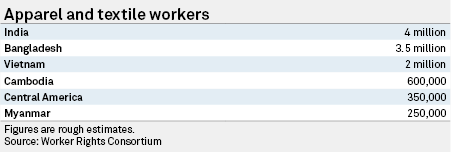
In Bangladesh, home to an estimated 3.5 million apparel and textile workers, orders for ready-made garments worth $1.5 billion have been canceled or put on hold.
Source: AP Photo
In response to the coronavirus pandemic, a raft of western brands have temporarily shuttered tens of thousands of retail stores, triggering a sharp drop in demand and the termination of many orders from Asian and central American factories that supply the products to western markets.

H&M  Hennes Mauritz AB (publ) recently said it had closed 3,441 of the group's 5,062 stores, while German sportswear-maker adidas AG said it would temporarily shutter stores in North America, Canada and Europe to help stop the global spread of the coronavirus. Similar shop closures have been announced by others, including Apple Inc., electronics retailer Best Buy Co. Inc. and Primark, the discount clothing company owned by the U.K.'s Associated British Foods PLC.
The closures are sending shock waves thousands of miles to developing markets where many of these products are manufactured. Initially, those factories were hit when the coronavirus outbreak in China impeded the delivery of raw materials.
Now the problem is disappearing orders. While, for instance, many western brands continue to pay their employees, very few factory workers in Bangladesh, India, Cambodia, Mexico and elsewhere have equivalent support either from factory owners or their governments. As a result, millions of workers who barely earn a living wage, and their families, are suddenly in dire financial straits.
"Supply chains don't stop at the border," said Scott Nova, executive director at the Worker Rights Consortium, a labor rights group in Washington, D.C. "Either brands and institutions in wealthy countries step up and help pay these workers or we'll see a human catastrophe across the supply chain and thousands of businesses will close, never to return."
SNL Image
The fear is that brands will now refuse to honor orders already placed. The IndustriALL Global Union, which represents 50 million workers in 140 countries in the mining, energy and manufacturing sectors, described the COVID-19 outbreak as an "existential crisis" for the garment industry.
"Not only are major brands and retailers canceling future orders, they are refusing to take responsibility for garments that have already been produced, using emergency provisions in contracts to stop shipments and avoid paying for the goods they ordered. This leaves factories holding the goods, unable to sell them to the customer that ordered them, and in many cases unable to pay the wages of the workers who made them," the union said.
In Bangladesh alone, orders for ready-made garments worth $1.5 billion have been canceled or put on hold, according to local media reports citing data from the Bangladesh Garment Manufacturers and Exporters Association. In a recent letter posted on the association's website, its president, Rubana Huq, urged German brands to make good on their commitments. Huq wrote, "While the businesses in Germany receive government support and address their losses, at our end we have an existential problem as we have to pay our workers." The Garment Manufacturers Association in Cambodia has made a similar plea to brands.
Workers are especially vulnerable in the key export markets of India, which has 4 million clothing and textile workers, Bangladesh with 3.5 million, Cambodia with 600,000 and Myanmar with 250,000. According to Dutch nonprofit organization Clean Clothes Campaign, workers at a factory in Gazipur, Bangladesh, recently began a sit-in protest to demand due wages. "The factory was supposed to pay recently laid-off workers, but now refuses because of buyers canceling orders," the Dutch group said.
While many western brands are providing financial assistance to their employees, these offers do not appear to have been extended to workers in their supply chain. "Demand had dropped to zero or near zero, and factory owners are scrambling to stop production as quickly as possible to minimize cash commitments and inventory," Nova said.
Adidas and H&M declined to comment on the issue. In an emailed response to S&P Global Market Intelligence, Primark said, "The company is of course paying for inventory that is on the sea in transit, or delivered to distribution centers in each country of origin. The company is also engaged in one-on-one discussions with the suppliers in order to explore other forms of mitigation."
But some factory owners have stepped up to the challenge. According to the Worker Rights Consortium, at least 25 apparel factories in Honduras have shut down for two weeks through March 29, with full pay for workers.
The COVID-19 outbreak, nonetheless, poses a risk even to those garment workers who are working, often in close proximity and crowded conditions. "Of the factories that are open, you start to wonder: should they be open?" said Christie Miedema, campaign and outreach coordinator of the Clean Clothes Campaign. "It's where the disease could be transmitted, putting lives at risk."


Original Source: https://www.spglobal.com/marketintelligence/en/news-insights/latest-news-headlines/consumer-brands-global-worker-army-faces-financial-shock-from-lost-orders-57739885

Saturday, April 20, 2019

Self Driving Banks vs Autonomous Vehicles an interesting viewpoint on the need for Financial Institutions Evolution

Banks should take inspiration from the autonomous vehicle industry, recognizing the value in creating certain autonomous financial customer journeys. The success of such features as automatic bill pay and investment sweep accounts have already told us this.
Read More from ISG Global Banking and Financial Services Partner 'Alan Hanson': http://bit.ly/2VVl7p5

Thursday, October 15, 2015

Global Payments Business – Challenges and Opportunities to Banks


The global payments industry is experiencing the digital disruption and opportunities across regions; it is in a state of fundamental transformation. Digitization of banking, digital-wallets, and surge in e-commerce acceptance are driving the growth in retail payments. However, the traditional corporate payment which is non-cash payment transaction type still is the major contributor to the global payments revenue. To take advantage of the opportunities offered in the global payments business, banks have to act fast and embrace the new age payments technology.
Key themes influencing these advancements are:
New Age Technology: Non-bank payment platforms are distrupting the global payments landscape with m-payments and e-payments. E.g: Globally most or all major e-commerce platforms has enabled digital wallets to improve customer experience.
Changing Customer Expectations: With increased internet and smart phone penetration globally and consumer preference towards digital payments are fuelling growth in non-cash payments market. Which also challenges the legacy payment methods to innovate.
Changing Global Demographics: Europe and Americas non-cash payments were high, but Emerging regions like APAC, South America and Africa non-cash payments are growing to outpace the developed markets soon.
E-commerce & Online Security: Migration of many retail brands to online market places to grow revenues; enhanced online security are increasing the consumer confidence on e-commerce spending.
Growing Impact of Regulation & Industry Initiatives: European Unions revised (PSD II), EMV adoption in US, Real Time Retail Payments intiatives, Pressure on Cards Interchange Fees, Merchant Acquisition Fees, NFC, SEPA, Virtual Currency Regualtion are all driving positive growth in payments market
Disruptive Non-Bank Payments Platform Providers
Payments were a service traditionally provided by banks, are now provided by innovative non-bank payment providers, who are rapidly gaining ground in the developing/emerging markets and among under-banked demographic segment. Technological leapfrogging can be clearly seen in the developing world, where traditional payments infrastructure is lacking. Paypal, Alipay, Western Union, MoneyGram, M-Pesa, Bitcoin and Prepaid Wallets are few examples which disrupted the payments business globally:
  • Paypal is fast growing number of customers globally for payments, also partnered with international e-commerce providers for Cross Boarder e-commerce inclusion. Alipay and Paypal continue to dominate as most preferred e-wallets types globally.
  • Western Union and MoneyGram are the largest remittance payments providers globally, where the banks have huge potential to tap in.
  • M-Pesa has demonstrated success in Kenya by providing payments services for un-banked customer segment and recently entered Europe.
  • Prepaid Wallets like Paytm, Mobikwik, Freecharge, and PayZapp are widely used for payments in e-commerce, taxi booking, mobile recharge, bill payments, travel ticket booking, and movie ticket booking.
  • Apple Pay, a NFC based payment technology has potential to grow with improving technology infrastructure landscape in retail outlets globally
  • Bitcoin provides a unregulated payments propositions
Non-Cash payment instruments such as cheque, Debit Cards, Credit Cards, Prepaid Cards, interbank electronic transfers, cross boarder electronic transfers, and pre-paid mobile wallets are all targeting revenue growth aiming to replace physical cash handling in the long term.
Expected Competition from Technology and Social Media Companies
Global Large technology and social media companies such as Apple, Amazon, Google, and Facebook are eying opportunities in payments business; by providing secure and straightforward payment options they can leverage and monetize millions of customers who already use their non-payment offerings. Clearing houses, network solution providers are also posing challenges to banks in the form of changing the way the multi-currency capabilities are delivered and impacting the value proposition of traditional correspondent banking models.
The tech savvy generation is taking leadership in global commerce, who are very familiar with social media and e-commerce are expected to adopt new age technologies to run their business.
Tapping the Opportunities in Global Payments Business
Banks have not been the quickest to respond or adapt to new technological advancements or customer expectations but this is the time to wake-up and respond to remain as key players in payments business.
Payments will not remain as utility products from banks in the future, there should be value addition. Successful payment providers will be those:

  •  Taking payments business into banks strategic growth priorities and devising a market specific payments business strategy that recognizes the unique needs, character, and evolution of payments business
  • Identify and penetrate the lines of business where payments are prominent
  • Target high-growth and traditionally under-served customer segment
  • Adopting and upgrading the technology infrastructure to deliver services and solutions in-line with customer expectations
  • Partnering with disruptive technology providers, social media companies, to enable access to technology and new customer base
  • Position themselves for increasing cross border and global nature of payments through multi-currency offerings
  • Targeting global remittances business aimed at high-growth economies such as Middle East, South Asia, and Africa
  • Constantly involve in pro-actively advising associations and regulators to shape the future regulatory framework


Definitions & Further Discussion:
E-Payments: Retail and travel sales; digital downloads purchased via any digital channel, and sales from businesses that occur over primarily consumer-to-consumer (C2C) platforms such as eBay. (Source: World Payments Report 2014)
M-Payments:  Form of payment where the mobile phone is used as a payment method–not just as an alternative channel to send the payment instruction – and the payment information flow takes place in real-time. (Source: World Payments Report 2014)
PSD:  Payment Services Directive
Figure: Global E-Transaction Payment Mix
  • By 2017, alternative payment methods will account for 60% of all transaction, an increase from 43% in 2012
  • 17% of global e-transactions were made using e-wallets in 2012, replacing that of credit and debit cards
  • Cash on delivery will account for 2% of global e-transaction by 2017
  • In 2012, 29% of e-transaction are made using non card methods in US and Canada, which was 41% in Europe, 53% in LATAM, 66%% in MEA
  • Globally, Europe and US are relatively slow in the uptake of new payment technologies owing to the widespread existence of legacy technologies
  • The developing markets such as Brazil, China and India are leading the way in adopting and innovating the new age payment technologies, given these markets are home to an increasingly middle class and mobile population who are tech savvy generations and more open to new ideas fueling demand for innovative, technology driven and easily integrated transaction methods.

PS: Kindly continue the discussion using the comments section.

Friday, March 13, 2015

Business Model Innovation

Availing taxi service has been simplified by Uber – the business model disruption erupted, taxi owners called for a massive strike globally, “how can simple mobile applications company without owning a single taxi can change the way this multi-billion dollar business has been done for decades?”
On the day of mass taxi strike, bookings on Uber has shot-up to 800%+ when compared to a regular business day; this helped Uber in a massive way with free publicity, mass viral marketing, more mobile app downloads, prime-time news coverage across geographies. Uber went on expansion spree with more mobile users were downloading its application without even targeting. Eventually no one is stopping anyone from using Uber, it’s a business model disruption like once dream of flying made possible by Wright Brothers first powered flight, the mode of long-distance commuting changed. 
When e-commerce for ticketing was introduced, the way you book or buy tickets completely changed. Today travel ticketing, hotel booking are the major e-commerce spend globally.
Razor and Blade Business Model!!
Gillette for decades sold the razor at clearance-give-away prices, but sold the blades for a bomb. Who saw this as an opportunity to implement in their own business “Business Model Innovation”?
  • HP did it, sold its inkjet printers at low-cost with a premium pricing on ink
  • Nestle Nespresso creatively copied this model, by selling cheap coffee machines and expensive coffee
  • Amazons Kindle, sold cheap digital readers to sell e-versions of books at high price when no material and shipping cost is involved
  • Apple iTunes, disrupted the music industry by giving free iTunes application but charging for every music download, made music CD’s and DVD’s obsolete very soon, also made downloaded music not shareable between multiple users which was the major leap forward in protecting IP in digital content
There are 55 such business model patterns identified by researchers at University of St.Gallen, which was borrowed from an industry/business to different industry/business.
What is your business model innovation?
Use the comment section to write about your observation, ideas, and more on this discussion topic.

Wednesday, December 11, 2013

What does the day 11-12-13 have in store?

What does the day 11(November)-12(Day)-13(Year) have in store? Consider the following:

•    It is the 316th day of the year in the Gregorian calendar. There are 49 days remaining until the end of the year.


•    David's Bridal estimates that more than 3,000 couples will get married on 11/12/13; compared to Nov. 11 of last year, that’s a 722 percent increase.


•    Fueling the rush to the altar on 11/12 this year is the rarity of it: the next consecutively-numbered date doesn’t roll along until Dec. 13, 2014.


•    After that, in purest numerical form, another consecutive date won’t mark the calendar again until next century.


•    At 2:11:21 a.m., it will be 12/11 2:11:21 which is three repeats of three numbers: 121-121-121.


•    At 8:09:10 a.m., the time and date will read as 8:09:10 11/12/13, a full complement of consecutive numbers.


•    At 2:15:16 p.m., when stated in military time, it will be 11/12/13 14:15:16; a series of six increasing numbers.


•    For a simple sequence, at 9:10 p.m., it will be 9:10 11/12/13.


•    At 10:21:11 p.m., when stated in military time, it will be 11/12 22:21:11, which gives us a palindrome of 11122-22111.

Source: mother nature network “www.mnn.com”

Monday, December 9, 2013