Showing posts with label Textile. Show all posts

Thursday, March 26, 2020

Impact of COVID19 Pandemic on Textiles Manufacturers: Farmers, Spinners, Weavers, Garments take a huge hit; Millions of workers to go into financial crisis, and manufacturers bankrupt;

#Repost #spglobal #marketintelligence

Consumer brands' global worker army faces financial shock from lost orders: Millions of workers in countries including Bangladesh, India and Cambodia are facing financial peril as western consumer goods companies cancel orders and local factories are forced to close.

Millions of supply-chain workers who make clothes, shoes, toys and electronic gadgets for western brands are facing an unprecedented financial crisis as orders worth billions of dollars are canceled overnight and local factories are forced to close.
SNL Image
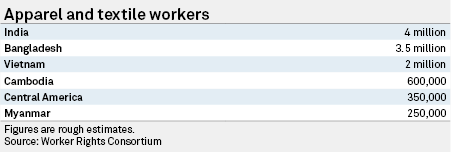
In Bangladesh, home to an estimated 3.5 million apparel and textile workers, orders for ready-made garments worth $1.5 billion have been canceled or put on hold.
Source: AP Photo
In response to the coronavirus pandemic, a raft of western brands have temporarily shuttered tens of thousands of retail stores, triggering a sharp drop in demand and the termination of many orders from Asian and central American factories that supply the products to western markets.

H&M  Hennes Mauritz AB (publ) recently said it had closed 3,441 of the group's 5,062 stores, while German sportswear-maker adidas AG said it would temporarily shutter stores in North America, Canada and Europe to help stop the global spread of the coronavirus. Similar shop closures have been announced by others, including Apple Inc., electronics retailer Best Buy Co. Inc. and Primark, the discount clothing company owned by the U.K.'s Associated British Foods PLC.
The closures are sending shock waves thousands of miles to developing markets where many of these products are manufactured. Initially, those factories were hit when the coronavirus outbreak in China impeded the delivery of raw materials.
Now the problem is disappearing orders. While, for instance, many western brands continue to pay their employees, very few factory workers in Bangladesh, India, Cambodia, Mexico and elsewhere have equivalent support either from factory owners or their governments. As a result, millions of workers who barely earn a living wage, and their families, are suddenly in dire financial straits.
"Supply chains don't stop at the border," said Scott Nova, executive director at the Worker Rights Consortium, a labor rights group in Washington, D.C. "Either brands and institutions in wealthy countries step up and help pay these workers or we'll see a human catastrophe across the supply chain and thousands of businesses will close, never to return."
SNL Image
The fear is that brands will now refuse to honor orders already placed. The IndustriALL Global Union, which represents 50 million workers in 140 countries in the mining, energy and manufacturing sectors, described the COVID-19 outbreak as an "existential crisis" for the garment industry.
"Not only are major brands and retailers canceling future orders, they are refusing to take responsibility for garments that have already been produced, using emergency provisions in contracts to stop shipments and avoid paying for the goods they ordered. This leaves factories holding the goods, unable to sell them to the customer that ordered them, and in many cases unable to pay the wages of the workers who made them," the union said.
In Bangladesh alone, orders for ready-made garments worth $1.5 billion have been canceled or put on hold, according to local media reports citing data from the Bangladesh Garment Manufacturers and Exporters Association. In a recent letter posted on the association's website, its president, Rubana Huq, urged German brands to make good on their commitments. Huq wrote, "While the businesses in Germany receive government support and address their losses, at our end we have an existential problem as we have to pay our workers." The Garment Manufacturers Association in Cambodia has made a similar plea to brands.
Workers are especially vulnerable in the key export markets of India, which has 4 million clothing and textile workers, Bangladesh with 3.5 million, Cambodia with 600,000 and Myanmar with 250,000. According to Dutch nonprofit organization Clean Clothes Campaign, workers at a factory in Gazipur, Bangladesh, recently began a sit-in protest to demand due wages. "The factory was supposed to pay recently laid-off workers, but now refuses because of buyers canceling orders," the Dutch group said.
While many western brands are providing financial assistance to their employees, these offers do not appear to have been extended to workers in their supply chain. "Demand had dropped to zero or near zero, and factory owners are scrambling to stop production as quickly as possible to minimize cash commitments and inventory," Nova said.
Adidas and H&M declined to comment on the issue. In an emailed response to S&P Global Market Intelligence, Primark said, "The company is of course paying for inventory that is on the sea in transit, or delivered to distribution centers in each country of origin. The company is also engaged in one-on-one discussions with the suppliers in order to explore other forms of mitigation."
But some factory owners have stepped up to the challenge. According to the Worker Rights Consortium, at least 25 apparel factories in Honduras have shut down for two weeks through March 29, with full pay for workers.
The COVID-19 outbreak, nonetheless, poses a risk even to those garment workers who are working, often in close proximity and crowded conditions. "Of the factories that are open, you start to wonder: should they be open?" said Christie Miedema, campaign and outreach coordinator of the Clean Clothes Campaign. "It's where the disease could be transmitted, putting lives at risk."


Original Source: https://www.spglobal.com/marketintelligence/en/news-insights/latest-news-headlines/consumer-brands-global-worker-army-faces-financial-shock-from-lost-orders-57739885

Wednesday, November 23, 2011

CYRUS P MISTRY SUCCESSOR OF RATAN TATA


The long wait is over now. After 18 meetings of selection committee to choose the next chairman of India's industrial pillar Tata Sons, the official announcement is made in-front of media and public. The next legend in Indian industrial history 

Ratan Tata announced his successor as Cyrus P Mistry.

“I will be committed to working with him over the next year to give him the exposure, the involvement and the operating experience to equip him to undertake the full responsibility of the Group on my retirement,” Tata said.

Mr. Mistry said he was deeply honoured by this appointment. “I am aware that an enormous responsibility, with a great legacy, has been entrusted to me,” he said in a statement.
He announced that he will legally dissociate himself from the management of his family businesses to avoid any issue of conflict of interest. Shapoorji Pallonji Mistry, father of the new deputy chairman of Tata Sons, owns 18 per cent in Tata Sons. The Shapoorji Pallonji Group is into construction, textile, water treatment and other businesses. Cyrus Mistry is currently the managing director of the $ 2 bn SP Group.

Executive Profile of Cyrus P Mistry : Shri. Cyrus Pallonji Mistry serves as Senior Vice President of Production of DQ Entertainment Plc. Mr. Mistry serves as Senior Vice President of Business Development and Technology at DQ Entertainment (International) Limited. He serves as Chairman of the Board of Shapoorji Pallonji Group and Afcons Infrastructure Limited. He has over 22 years of experience in the Indian entertainment industry in the fields of filmmaking and animation, technical and production pipeline management. Mr. Mistry serves as a Director Tata Sons Limited. He has been a Non-executive Director of Forbes & Company Ltd. (alternate name: Forbes Gokak Ltd.) since June 23, 2003. He was associated with Convergence Media Private Limited India, as Senior Vice President - Operations and Planning and UTV Toons India. Mr. Mistry serves as Director of following companies: Forvol International Services Ltd., Shapoorji Pallonji & Co. Ltd., Cyrus Investments Ltd. Shapoorji Pallonji Power Co. Ltd., Buildbazaar Technologies (India) Pvt. Ltd., Sterling Investment Corporation Pvt. Ltd., Samalpatti Power Co. Pvt. Ltd., Shapoorji Pallonji & Co. (Rajkot) Pvt. Ltd., Shapoorji Pallonji Finance Ltd., Shapoorji Pallonji Infrastructure Capital Co. Ltd., Oman Shapoorji Construction Co. Ltd., and Muscat Pallonji Shapoorji & Co. Pvt. Ltd. He served as a Director of Tata Elxsi Limited, from September 24, 1990 to October 26, 2009. Mr. Mistry served as a Director of Tata Power Co. Ltd. until September 18, 2006 and of United Motors(India) until November 26, 2009. He served as Director of Gokak Textiles Ltd. until July 7, 2008. He is Fellow of the Institute of Civil Engineers. Mr. Mistry holds B.E.(Civil Engineering) from Imperial College, London and Master of Science in Management from London Business School. He holds a Bachelor of Commerce from Mumbai University. He is also on the board of the Construction Federation of India, the Imperial College Advisory Board, the board of governors of the National Institute of Construction Management and Research (NICMAR).

Let the next lion rule. Wish him all success.

Saturday, August 28, 2010

Major Hurdles in INDIAN TEXTILES - Human Resource, Volatile Market, Cotton Price, Slower Returns, Electricity.

In India the culture of silk was introduced in 400AD,while spinning of cotton traces back to 3000BC.


Indian textile enjoys a rich heritage and the origin of textiles in India traces back to the Indus valley Civilization where people used homespun cotton for weaving their clothes. Rigveda, the earliest of the Veda contains the literary information about textiles and it refers to weaving. Ramayana and Mahabharata, the eminent Indian epics depict the existence of wide variety of fabrics in ancient India. These epics refer both to rich and stylized garment worn by the aristocrats and ordinary simple clothes worn by the common people. The contemporary Indian textile not only reflects the splendid past but also cater to the requirements of the modern times.


A Labour Intensive Industry is now facing a major hurdle called "Man Power Shortage". 

Will it be resolved ? or else the industry will be wiped away from INDIA ?

Textile sector accounting for 30% of Indian exports will be in vein then, global clothing sector will face trouble in getting enough productions. World of Textile will face various difficulties, if Indian Textile market stumbles.

China,Pakistan and Bangladesh being our major competitors with surplus manpower and lower production cost is now raising the edge to dominate the market. 

Electricity Interruption and Cotton Price questions the Survival!

India is second largest producer and consumer of textiles globally is in need of man power and legal support. With high electricity interruptions, we already lag behind the target, additionally few more problems like frequent power crisis is  disturbing the industry. Cotton export is open from October 2010, which will eat the complete cotton production of 2010.From a month back ginning industry started to stock the production to export, this drastically increased the cotton price 20% hike in per candy price.  New cotton is expected by the end of November 2010. Hope new stocks will serve Indian needs.

Volatile Market and Slower Returns not like IT to deal with !
Cotton. Yarn. Clothing. Woolen. Rayon. Synthetic. Polyester. Technical Textiles. Agriculture. Natural Disasters. Climate.

When we speak about, Volatile Market and Slower Returns, we are forced to consider all the above fields. Climate, Natural Disaster accounts for major agricultural - Cotton production loss, which is the major production area. When it comes to cost of agricultural production, modern machineries are used because of labour shortage in breeding and sewing seeds to getting the agri product ready - it needs more money, so this is the start up place for increased production cost.

Next comes the ginning segment, where today lots of modernization takes place and automatically when investments goes high automatically quality, production cost and profit returns are expected high. Here the investment returns are obtained 88% successfully.

Next Comes the Spinning segment, where the advancement is at its peak and huge infra and investment is expected gives a very slow returns. This Spinning segment is one of the widely spread-ed one, where cotton converted in to cotton yarn, synthetic made in to synthetic yarn, polyester converted in to poly-yarn, woolen converted in to wool-cotton-polyester yarn (Mixture can be any kind), Rayon converted in to Cotton-rayon-yarn. So, here all the conversion process takes place after treating the raw material in wide process ares under different conditions and shapes.

Next comes warping, weaving, clothing segment. Where the any yarn output is made in to grey cloth and utilized for different fabric materials and shapes, designs are made. 

Next comes Knitting - Garment  segment. Where a final shape of cloth is made like Shirts, T-Shirts, Trousers, Suitings, Inner wears, Table Cloth, Screen Cloth, Socks, Jersey's,Denim's non-woven fabrics and many more.

Next Comes the Hand Loom and Auto Loom segment. Where the Saree, Bead spread, Towels, Terry Products and lot more are produced.

Human Resource a Serious Issue..,

Above said all segments were integrated with a huge number of processes, industries, businesses, manufacturers,labour's, farmer's, buyer's, seller's, marketing agencies and lot more were engaged in this textile segment in total.

So a final product like Under wear, Tie, T-Shirt are reaching the desired segment of people after surpassing various quality standards and tests. A single textile product in any store is hard work of the whole textile society. Farmer to seller everybody involved and every one needs a income to survive automatically as per the social & economic needs salaries are increased, product cost was raised time to time. 

Even though we are getting slow returns for our huge investments. This is how the manufacturing industry of India facing physical, Financial, social, economical and climatic problems and still overcoming every hurdle to survive and employing the 46% of Indian Population in different ways and in need of more man power. Will we survive ? this is answered periodically and the question arises periodically again and again.

We should get more man power to survive or else survival is really really difficult.